#CULTROUTE Skarbek Palace in Rozhniativ – an aristocratic touch of history in the Boikivshchyna region
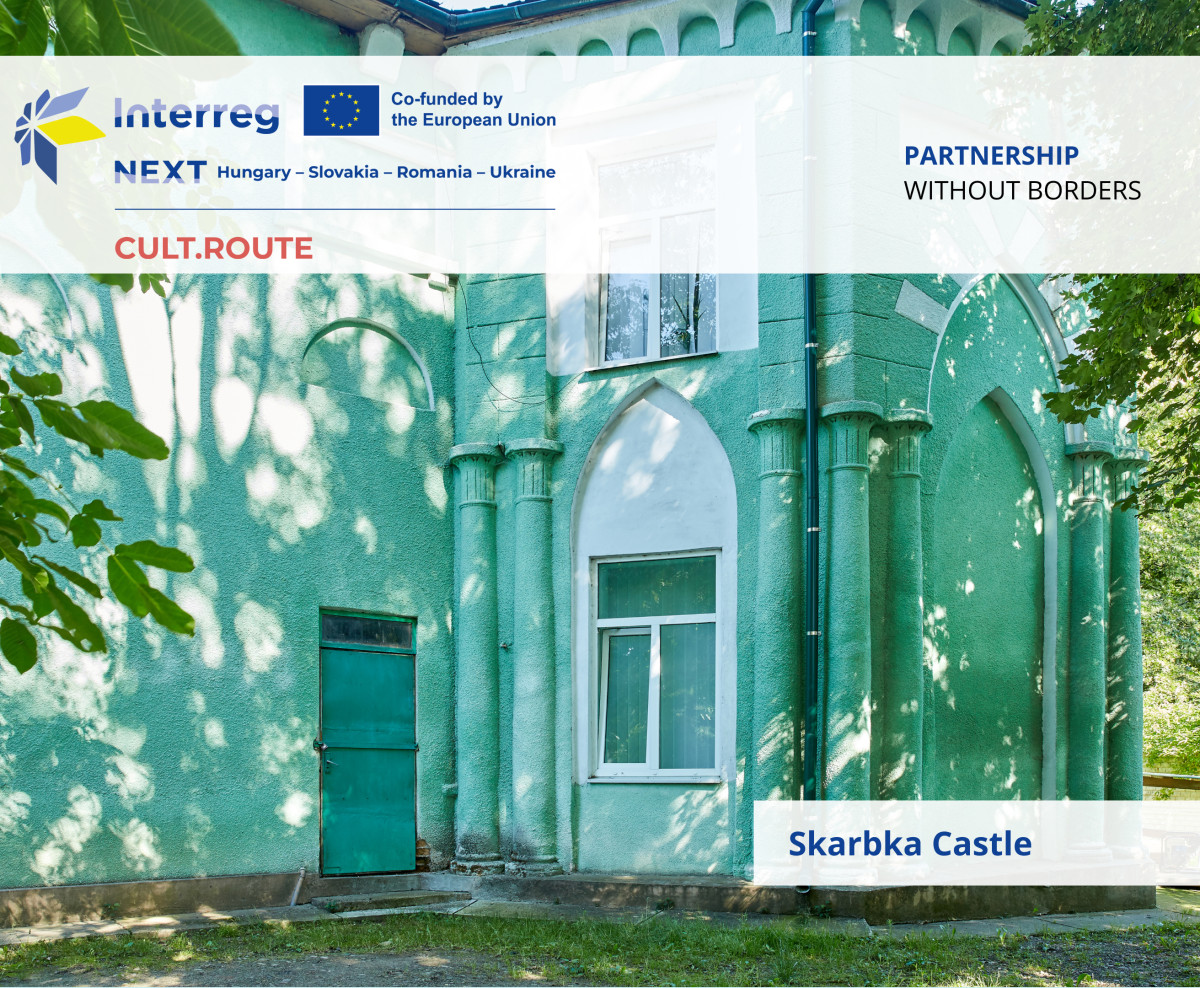
Rozhniativ Castle – Skarbek Palace, XVII-XIX centuries.
One of the oldest settlements in the Boikivshchyna region is Rozhniativ. The village, located in the foothills of the Carpathian Gorgany Mountains, was obviously established as a defensive and logistical location for local trade routes. To this day, scholars disagree on when the castle in Rozhniativ was built. The oldest substantiated assumptions date back to the XV century and link the construction of the castle to the noble family of Strutynski of the Sas coat of arms, who owned these estates.
Mentions of Rozhniativ Castle begin to appear in historical sources from the middle of the XVII century, when, after a series of victorious battles by the hetman of the Zaporizhzhia Army, Bohdan Khmelnytsky, protests against the nobility began in the land of Halychyna. Thus, in 1648, the castle in Rozhniativ was among the fortresses that were captured and destroyed. At that time, it was owned by Samuel Poniatowski, who actually filed a lawsuit for damages caused by the uprising. The Rozhniativ Castle was looted and burned for the second time by Cossack troops and rebellious peasants in 1650.
The restoration of the stronghold took some time, but by 1672, the Rozhniativ outpost was again listed as an important defensive location in the Boikivshchyna region. During the Polish-Turkish wars, the then Crown Hetman Jan Sobieski (the future King Jan III Sobieski) instructed the commanders of the castle garrison in Rozhniativ to organise an ambush on the Tatar troops of Khan Selim Giray in the neighbouring forests.
In the second half of the XVII century – early XVIII century, Rozhniativ Castle is mentioned as the property of the magnate family of Końecpolski. The family of the Bratslav voivode and Dolyna starosa Jan Aleksander Końecpolski and his wife Elżbieta Fevronia Żewuska possessed such wealth and estates that, according to contemporary accounts, they were equal to those of Greater Saxony.
Such great wealth naturally attracted powerful enemies, among whom was the Uniate Bishop of Lviv and Halychyna, Josyf Shumlyansky, whose bishop's estates were located in neighboring Perehyn and in the vicinity of Rozhniativ. Frequent disputes and lawsuits with the bishop led to Końecpolski ordering soldiers to burn Bishop Shumlyansky's estates in 1708, including Perehynske and the disputed Rozhniativ.
After the death of Końecpolski in 1719, who left no descendants, the line of this family ended, and Rozhniativ passed to the heirs of his wife, the Zhevusky family. The new owner of the castle, Wacław Zhevusky, the Podillia voivode and Dolyna starosta, often visited Rozhniativ. This is evidenced by the agreements concluded in the Rozhniativ fortress in 1758 between the starosta and the tenants of the surrounding salt mines. In general, the condition of the castle is described in an inventory from 1759, which mentions the fortification of the fortress with earthen ramparts, the presence of an entrance gate and a suspension bridge, a residence, a stone tower, a bakery, a carriage house, and other farm buildings and fortifications. The castle also had two underground secret passages, one of which can still be traced in the lower part of the preserved tower.
In the second half of the XVIII century, Rozhniativ became the property of the Skarbek family. One of the most prominent representatives of this family was Stanislav Skarbek, who inherited the castle from his grandfather around 1793. At the beginning of the XIX century, this great patron of culture and philanthropist began rebuilding the castle into a palace. Around 1830, the old fortifications were converted into a new neo-Gothic palace complex dominated by a high donjon tower. Count Stanislav Skarbek often stayed at the Rozhniativ palace and even organized social receptions and theater performances there. Sometimes you can find information about the Rozhnyativ Palace as Count Skarbek's hunting lodge, which is not unlikely, given the well-known hunting grounds near the Carpathians. At the end of his life, Stanislav Skarbek bequeathed a significant part of his income, including the Rozhniativ estates, to the maintenance of the Institute for Orphans in Dorohovyzh. After the patron's death in 1848, the Count Stanislav Skarbek Foundation was established from his estate.
The palace underwent significant reconstruction after the Second World War, when the famous tower was lost; the palace was redesigned and extended. Now the ancient palace houses the Rozhniativ Museum. The palace underwent significant reconstruction after World War II, when the famous tower was lost, and the palace itself was redesigned and extended. Now the old palace is used by the Rozhniativ Police Department, mindful of its unique cultural heritage.
This publication was produced with the financial support of the European Union. Its contents are the sole responsibility of Department of Investment Policy, Projects, International Relations, Tourism and City Promotion of Ivano-Frankivsk City Council and do not necessarily reflect the views of the European Union.