#CULTROUTE The Krzeczunowicz Palace in Bilshivtsi: the noble heritage of Halychyna
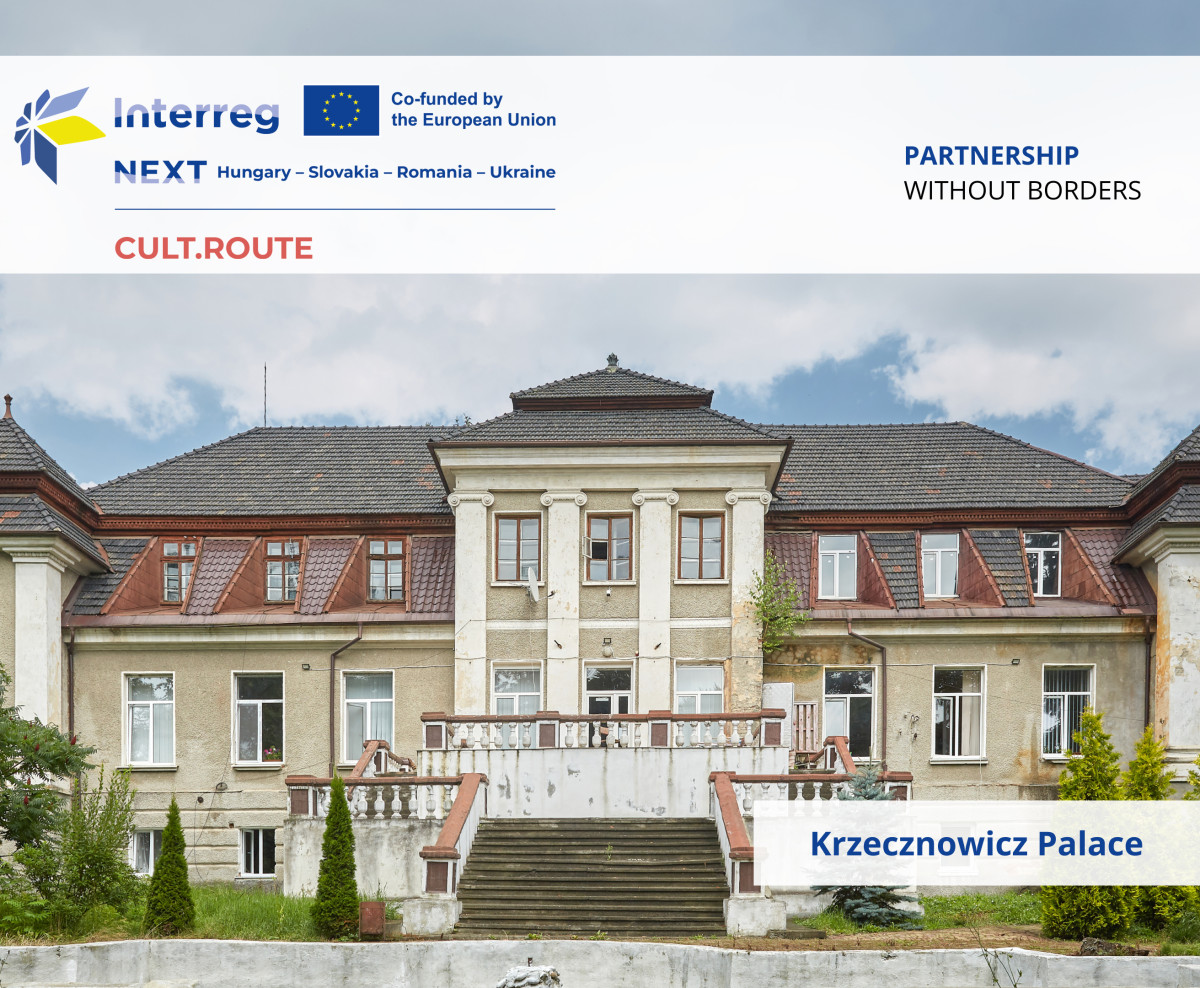
The village of Bilshivtsi, which once belonged to the towns of Halychyna, is located in the picturesque valley of the Hnyla Lypa River, not far from the chronicle-mentioned Halych. Bilshivtsi itself has a written history dating back to at least the beginning of the XV century, often appearing in documents under the name of Malyi Bolshiv (Malyi Bovshiv), apparently as one of the derivatives of the chronicle settlement of Bolshiv (Bovshiv), known since the middle of the XII century. During the late Middle Ages and early modern period, Bilshivtsi was owned by representatives of various noble families – the Kazanovski, Yablonovski, Maletski, and eventually the Kszeczunowicz. Practically every family left its mark on Bilshivtsi, trying to develop and strengthen the town.
Thus, under the patronage of the Kazanovski and Yablonovski families in the XVII–XVIII centuries, a Baroque church and monastery of the Visitation of the Blessed Virgin Mary were constructed, entrusted to the care of the Carmelite fathers. The construction of the Bilshivtsi Palace is associated with the Maletsky family and the Kszeczunowicz family. At the beginning of the XIX century, the town, which had been owned by the Maletski family until then, passed into the possession of the Kszeczunowicz family. The history of this family in the Galician lands dates back to the mid-XVII century, when the founder of the fortress city of Stanislaviv, Andriy Pototskyi, invited Armenian merchants from neighboring Lviv and the surrounding area to promote the economic development of the newly established urban center. Among the group of Armenians who settled within the walls of the Stanislaviv fortress was the Kszeczunowicz family. By the end of the XVIII century, the Kszeczunowicz family had been granted noble status with their own coat of arms by Emperor Joseph II of Habsburg, and by wealth and influence, they ranked among the most prominent Armenian families of the former Polish-Lithuanian Commonwealth.
The first owner of Bilshivtsi from the Armenian dynasty was Valerian Vartan Antoni Kszeczunowicz, who acquired the estate from local landowner Jozef Maletsky, probably in the first third of the XIX century. The new owner actively studied and developed agriculture; in particular, he was involved in breeding and even authored several manuals on beekeeping, horse breeding, and sericulture. Mr. Kszeczunowicz often stayed at his residence in Bilshivtsi, where he died in 1867, but was buried in the family chapel-tomb at the Lychakiv Cemetery in Lviv.
The old estate of the Bilshivtsi family is marked on Austrian military maps from the late XVIII century, but it was obviously wooden at that time, as it is not distinguished among the substantial (solid, brick) buildings of the town. It is not known exactly when and how the residence was rebuilt, but around 1800, while still owned by the Maletski, a new palace was built, which was rebuilt several times by the Kszeczunowycz during the XIX century. At that time, the palace looked like a three-story building with two side risalits and a slightly elevated central part.
Bilshivtsi suffered significant destruction during World War I, when almost all buildings in the central part of the town were damaged. After the war, the owner at the time, Oleksandr Kszeczunowicz, began actively rebuilding the town center, which is reflected in a saying that has been preserved among the residents: “He found Bilshivtsi wooden, and left it brick.” It was probably then that the Kszeczunowycz family began to consider rebuilding their family estate.
However, the most ambitious construction project to rebuild the palace and redesign its grounds took place under Kornel Kszeczunowicz in 1926–1929, who worthily continued his father's work. A well-known politician, writer, and military figure, he inherited his father's estates in Bilshivtsi and decided to rebuild the family residence completely. The architectural design was created by the famous Lviv architect Tadeusz Moklovsky.
The palace was designed in the neoclassical style as a two-story building with a dominant four-column portico, a large terrace, and monumental stairs leading to a British-style park covering an area of over 10 hectares. The front of the building was also complemented by two coats of arms symbolizing the last owners of Bilshivtsi. At the owner's initiative, the main building material was white hewn stone, the same as that used in the construction of the Galician Castle. In this way, Kornel Kszeczunowicz tried to emphasize the historical heritage of his residence with the former seats of the princes and kings of Galicia.
The broken four-pitched roof with windows in the eaves had an interesting design. The grand park - whose outlines remain visible to this day - is recalled by local elders with particular reverence, noting its exceptionally well-maintained condition, the diversity of its plants, and especially the variety of fragrant flower beds.
After the start of World War II, Kornel Kszeczunowicz and his family left Bilshivtsi and emigrated to France, and later to England. The owner never returned to his native estate. With the arrival of the communist regime, the palace complex was repurposed as a hospital and outpatient clinic. The building retained this status during Ukraine's independence, and today it houses the inpatient care department of the Galician Territorial Center for Social Services. It is necessary to mention that in 1995, Kornel's son, Andrzej Kszeczunowicz, visited the family estate where he spent his childhood before the war, later describing many interesting facts about Bilshivtsi in his memoirs.
This publication has been produced with the financial assistance of the European Union. Its contents are the sole responsibility of the Executive Committee of Ivano-Frankivsk City Council and do not necessarily reflect the views of the European Union.
#InterregNEXT #interregnexthuskroua #InterregnextHUSKROUA #CrossBorderCooperation #Interreg #HUSKROUA