#CULTROUTE Halytskyi Castle – witness to the history of Galicia
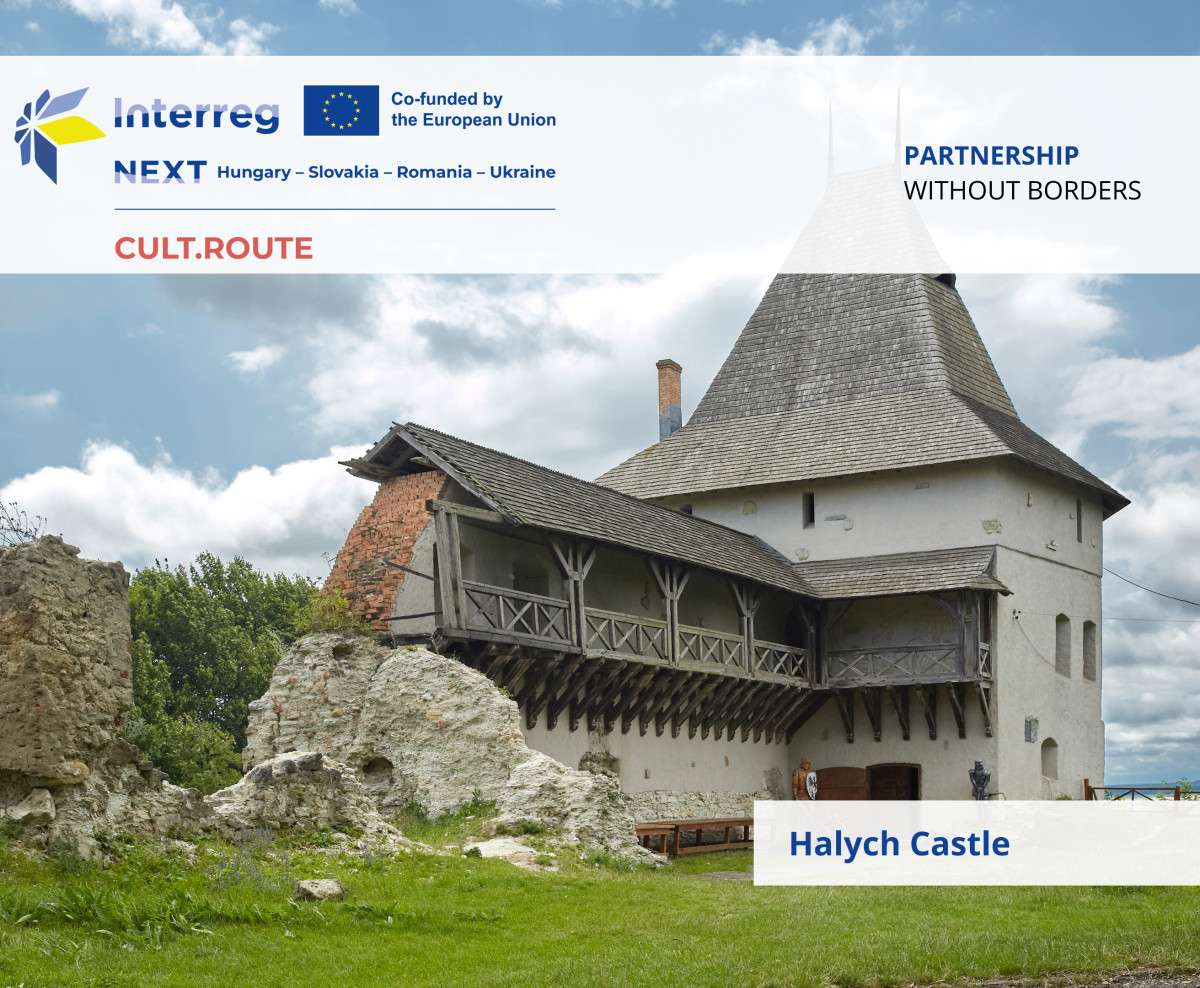
Halytskyi Castle, XIV-XVII centuries
Halych is one of the oldest cities in Ukraine, from which the name of the large western Ukrainian region “Halychyna” derives. In the Middle Ages, it was the capital of the Halych principality, and the vast territory of the former princely and king's center stretched across several settlements of the modern Halych community.
Evidently, as early as the XII century, there was a defensive courtyard on the Castle Hill in Halych, as it would have been completely misplaced to ignore such an attractive and inaccessible location in the Middle Ages. It is quite likely that in the first third of the XIII century, the residence of one of the most powerful and richest people in the Halych lands, Boyar Sudislav, was located here. Around 1230, the chronicle mentions Prince Danylo Romanovych's attack on Sudislav's defensive courtyard (castle), where provisions and weapons were stored, probably for defense.
It is interesting that when Danylo's army captured Sudislav's court, they found a large amount of wine in the cellars, so the excessive use of the trophy drink halted the army's movement for a day.
The construction of the Halych castle, the ruins of which have survived to this day, dates back to the second half of the XIV century. After the former possessions of the Romanovich state were included in the Grand Duchy of Lithuania, Poland, and Hungary, a new political and administrative center emerged in Halych at the foot of Castle Hill. Instead, the ancient princely castle remained the seat of the metropolitan church, headed by the higher clergy – Krylos (modern village of Krylos, Halych territorial community, Ivano-Frankivsk region).
The construction of a powerful, probably wooden castle, was carried out during the reign of Polish King Casimir III. On behalf of the king, the Halych stronghold was initially ruled by voivodes, and later by starosts (headman). In 1387, the Halych castle, headed by the Hungarian voivode Benedict, withstood the siege of the Polish-Lithuanian troops and was surrendered by its defenders only through a compromise favorable to them. The castle was visited several times by Polish kings: Władysław II Jagiełło in 1395, 1410, 1423, and 1427; Władysław III Warneńczyk in the 1440s; Kazimierz IV Jagiellon in 1448 and 1465; Jan Olbracht (1459–1501) in 1497; and Jan Kazimierz in 1653.
In the first third of the 15th century, the castle briefly belonged to Moldavian lord Ilia I Mushat. The most famous Halych starosts (headman) who took care of the stronghold during the XIV-XVII centuries were Benko of Zhabokruk, Mykhailo Muzhylo of Buchach, Stanislav of Khodcha, Mykola and Hieronim Sinyavskyi, Mykola Strus, Stanislav and Andriy Pototskyi.
During the XV-XVI centuries, the wooden castle was gradually rebuilt in stone. It is also worth mentioning the detailed inventory description of the Starost Castle in Halych from 1582. The active development of the residence of the king's starost (headman) during the middle and second half of the 16th century was carried out by Mykola and Hieronim Sinyavskyi, and blocks from the 12th-century Cathedral of the Dormition in Krylos, which was dismantled at that time, were often used as building material. In general, the castle was equipped with several stone and wooden towers, defensive artillery and ammunition, necessary provisions, and a malt house and brewery operated in Pidzamche. The archives of the zemstvo (district council) and town courts of the Halych lands were also kept and organized here.
The castle acquired its final form, which essentially turned it into ruins, after reconstructions in 1627 and 1658. The latter was carried out according to the plan of the famous French architect François Corassini. At that time, the castle was divided into upper and lower parts, and a claw-shaped bastion was erected, which significantly strengthened the fortress on the northern side. In general, the Halych castle had two gates: a judicial, noble, and entrance towers, a starost palace, and the chapel of St. Catherine. This is where court proceedings took place, the Sejm gathered for a certain period of time, and the archives were kept. Despite numerous assaults and sieges during the XIV-XVII centuries, the castle on Halych-Gora was captured and significantly destroyed in 1676 by the troops of the Ottoman commander Ibrahim Pasha, nicknamed Shaitan.
After the fall of Halych Castle, the city finally lost its position as the regional capital to the newly founded Stanislaviv (now Ivano-Frankivsk) nearby.
By the end of the XVIII century, the fortress was in ruins, and its gradual reconstruction began in 2001. To date, the Noble Tower and part of the wall with a gallery leading to the walls of St. Catherine's Chapel have been reconstructed. Over the past few years, active archaeological research has been conducted on the Entrance Tower, where traces of the central gate, full dungeons, and probable secret passages have been discovered.
This publication was produced with the financial support of the European Union. Its contents are the sole responsibility of Department of Investment Policy, Projects, International Relations, Tourism and City Promotion of Ivano-Frankivsk City Council and do not necessarily reflect the views of the European Union.